
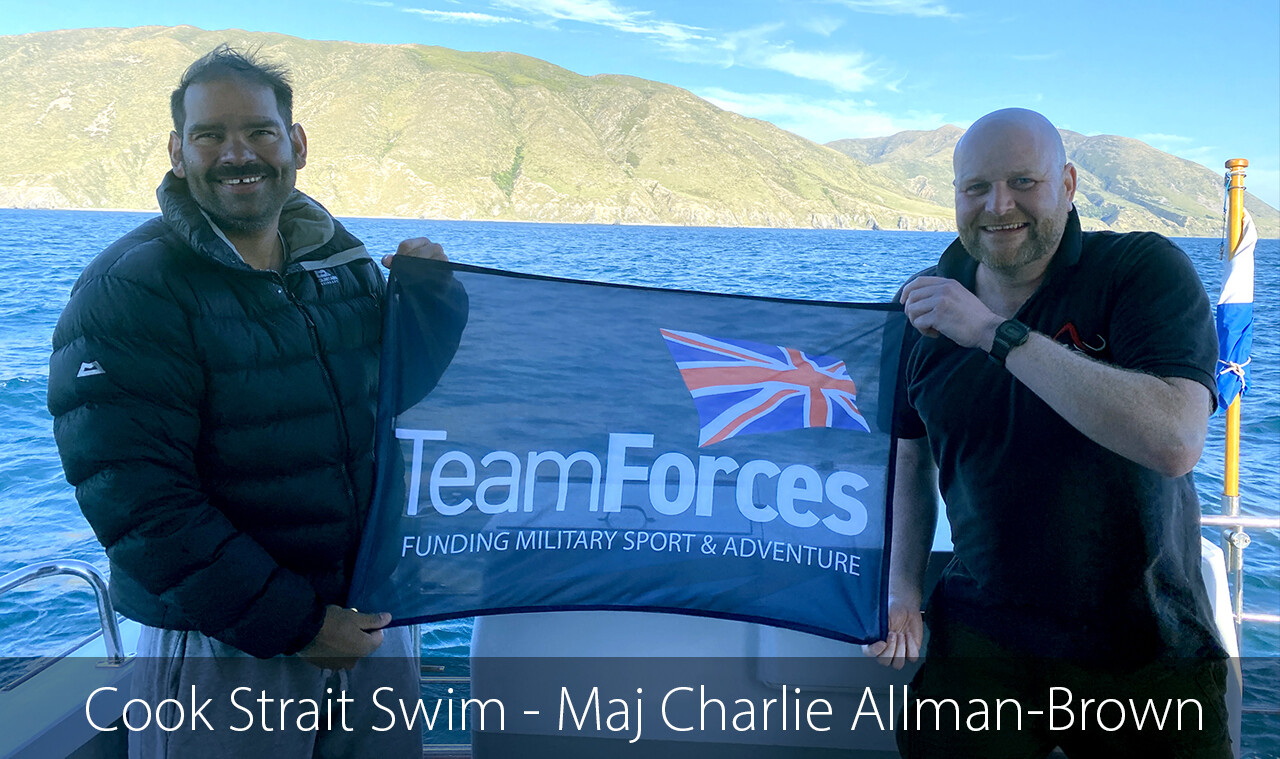
Team Forces proudly supported Major Charlie Allman-Brown earlier this year with a grant to enable his demanding solo swim across New Zealand’s Cook Strait – one of the world’s most challenging stretches of open water.
His achievement was remarkable not only for the physical and mental endurance required to complete the crossing, but also for the personal challenges he had to overcome simply to reach the start line. Charlie’s determination, resilience and commitment throughout the journey embody the values that sit at the heart of Team Forces.
We are proud to have supported this extraordinary endeavour, which stands as a powerful example of how challenge and adventure can inspire others, build resilience and demonstrate what can be achieved through perseverance and purpose.
Cook Strait Swim – Maj Charlie Allman-Brown
The Oceans Seven is a marathon swimming challenge consisting of seven open water channel swims. It was created in 2008 as the swimming equivalent of the Seven Summits mountaineering challenge. It comprises the Northern Channel (UK), the Cook Strait, the Molokaʻi Channel(Hawaii), the English Channel, the Catalina Channel (USA), the Tsugaru Strait (Japan) and the Strait of Gibraltar. The Cook Strait is widely considered among the most unpredictable.
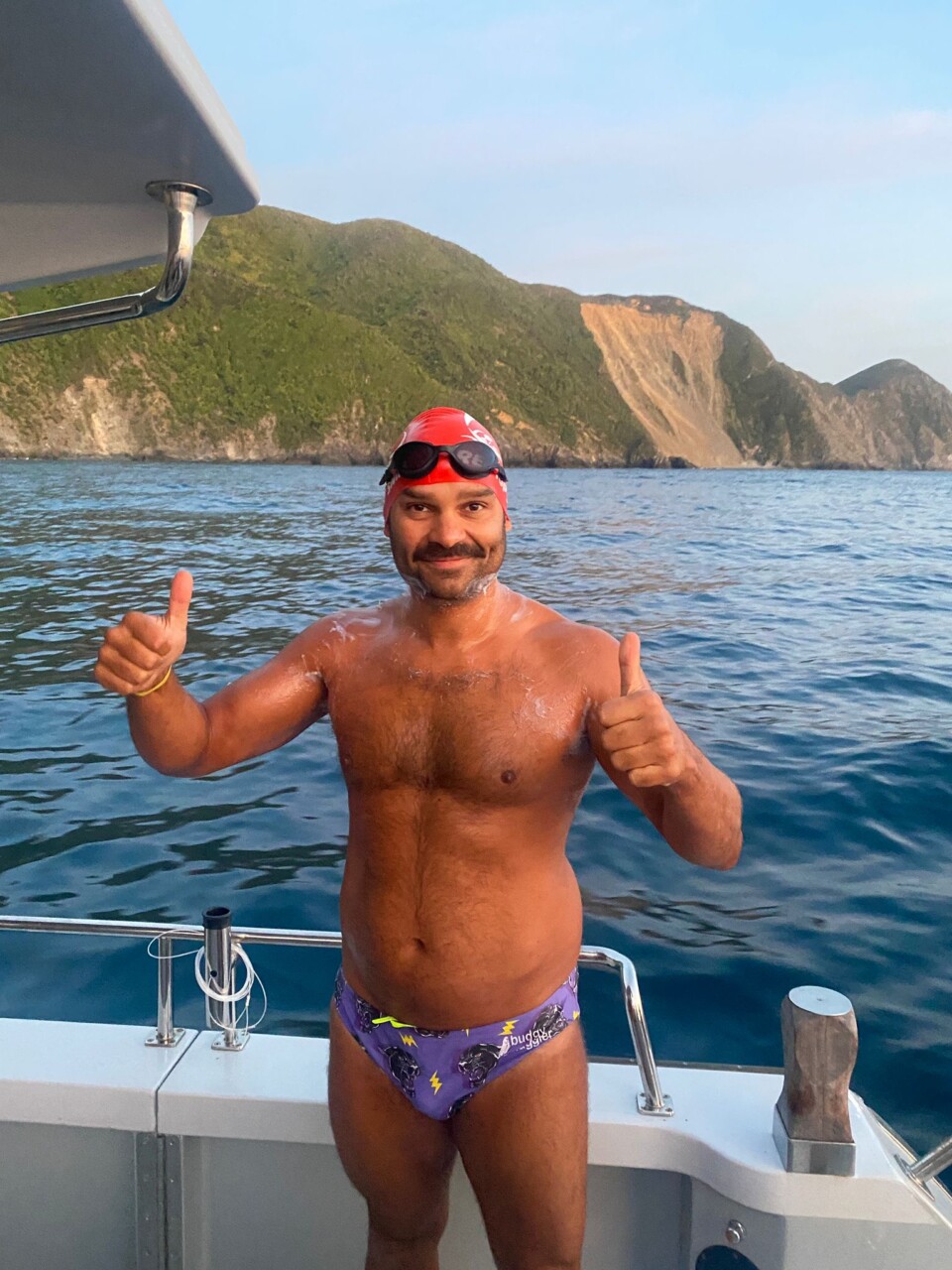
On the morning of 12 February 2026, I was sitting below deck chugging through the Marlborough Sound, waiting to start my swim across the Cook Strait. I had not slept in 48 hours because of jet lag and nerves. My swim window had come forward as a tropical storm was moving in from the Pacific Ocean and would wash out my scheduled time slot. The tide waits for no man. I was waiting for the word to go topside and start the swim. I received it around 0600 hrs. “Charlie, time to lube up! We’re on.”
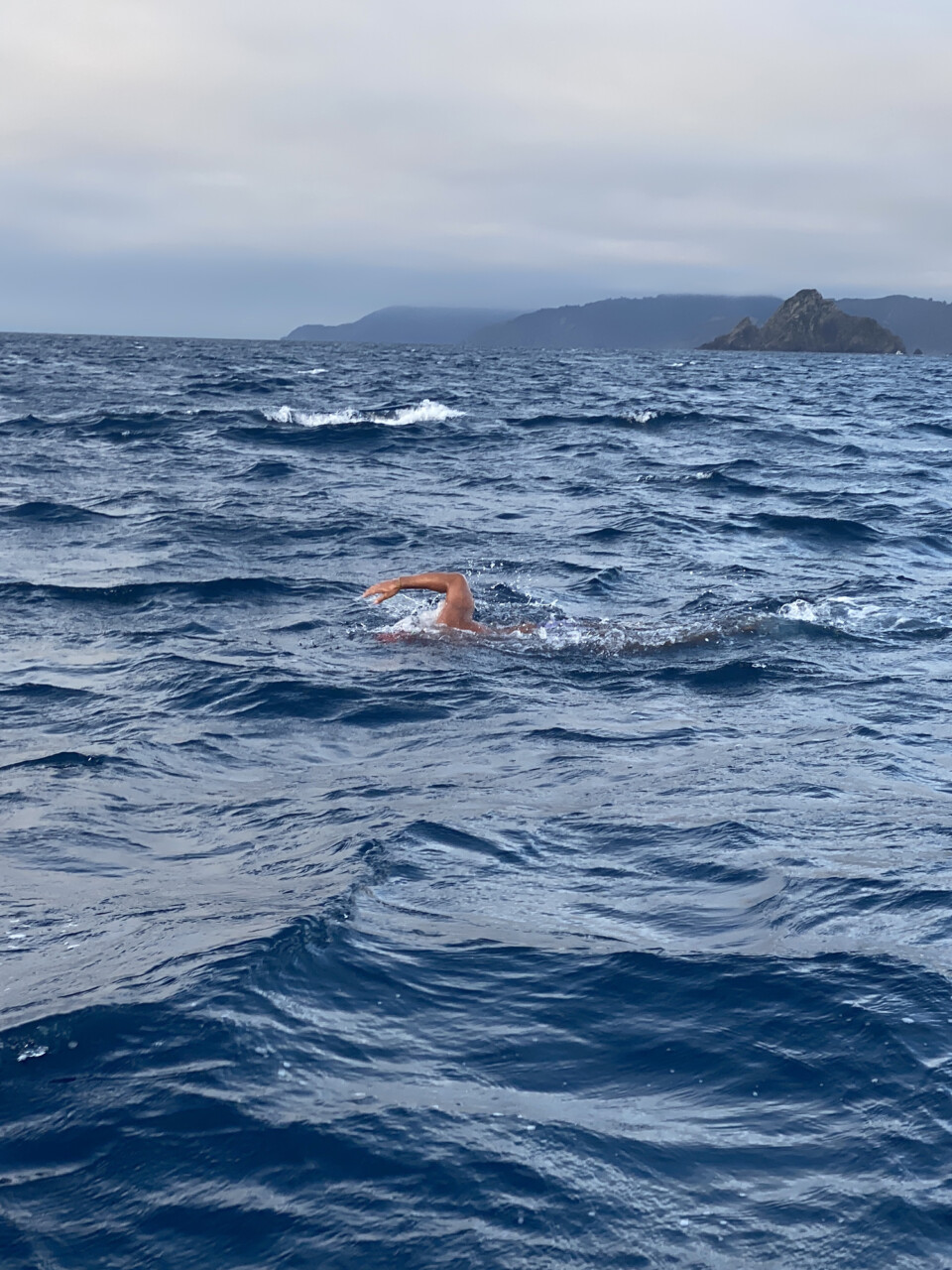
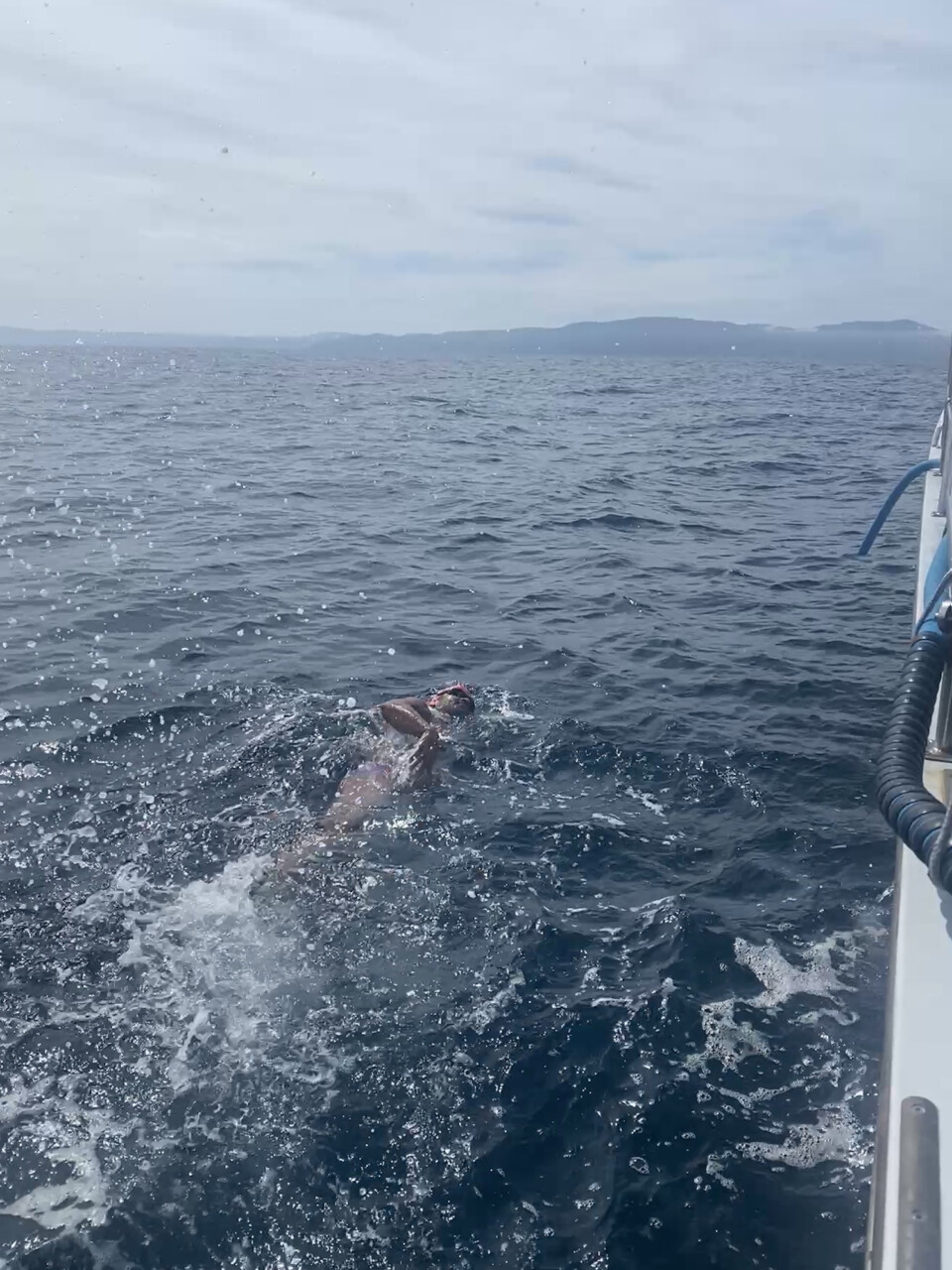
What followed was 11 hours and 57 minutes in some of the most demanding open water on earth. The Cook Strait measures 22 km point to point, but the tides and currents pushed my total distance to 28.1 km. The Pacific Ocean funnels through this narrow gap between New Zealand’s North and South Islands, creating cold, temperamental waters home to some very large marine life. After 6.5 hours I hit the flood tide head on and crawled forward at just 500 metres per hour for nearly six hours. Yet I kept going. Just keep swimming was all I said to myself, and I completed my second swim of the Ocean Seven.
“There is something in open water swimming that will be familiar to anyone who has served. The conditions don’t care about your plan. The tide doesn’t negotiate. At some point, the only question is whether you keep moving or stop. Those six hours crawling at 500 metres per hour taught me nothing I didn’t already know from soldiering. I have dug a hole for 36 hours straight on a defensive exercise and endured fatigue, hardship and fear on many an occasion.
My military experience gave me strength, confidence and drive. Never give up, stay motivated, and one can overcome the challenge in front of them. That is what the Army has taught me. Whatever the task, however little progress feels visible, the answer is always the same: choose to keep going and keep turning the arms.
Open water swimming strips you back to your core. It teaches you what you can endure and who you can become. As Sir Ernest Shackleton said: “Through endurance, we conquer.”
Maj Charlie Allman-Brown
Why Swim It?
People often ask, “Why do you do it?” Why endure pain, monotony, and risk? For me, the answer is simple. I love to swim – especially in the sea. Open water is wild, freeing, and grounding. It strips away the noise of modern life and reconnects me with nature. I also do it because others can’t or won’t. Knowing that I can keep going when it gets tough is empowering. As a friend wrote in a good luck card: “Where the mind is determined to go, the body will follow.” That mantra carried me through the hardest moments. I also enjoy the training. Focusing on the pursuit of excellence in one area has a way of improving many others in your daily life and habits. One achieves, and that is addictive.
Training in Oman
In June 2024, my family and I moved to Oman for my work. The facilities there allowed me to train for almost every aspect of the swim – except the cold. I solved that with cold baths. My plan was simple: improve technique, build distance, then acclimatise.
I had experience to draw on. In 2019, I swam the English Channel in 17 hours and 6 minutes. When I arrived in Oman, I joined the Marlins Swimming Club at the British School in Muscat. Training with faster swimmers pushed me out of my comfort zone and made me quicker. I averaged 30 km per week between pool and sea sessions, with 5–7 km pool sets and 10 km+ endurance swims in the ocean.
Coaching and Support
I could not have done this without the expert coaching of Tim Denyer and Matt Duggan from Red Top Performance in the UK. Red Top specialises in preparing swimmers for the Channel, the Ocean Seven, and other long distance swimming challenges. Their guidance, training structure, and encouragement were invaluable. Matt was also my observer on the day – and his motivational style was direct and effective. Five hours in, he told me: “Messages are coming in. Everyone’s behind you – so get a move on and don’t F%K it up.” Exactly what I needed.
My wife, Ellie, and my children were equally essential. Ellie took on the childcare and school runs so I could train early and late. Without her support, I would never have reached the start line.
A Race Against the Weather
I flew into Christchurch on 9 February. I had planned a few days of rest, but the tide waits for no one. Tim called to say that 12 February offered a perfect weather window – just before a major tropical storm. In channel swimming, when you’re told to go, you go. The storm hit the next day, flooding Wellington and Christchurch and shutting down the Cook Strait ferry for almost five days. Had I hesitated, I would have missed my chance entirely.
The Injury
I was more apprehensive than usual because I had picked up an injury a month before the swim. Old age got the better of me: I trapped a nerve in my neck while getting up from the sofa after working on my laptop. I twisted awkwardly and assumed it would pass in a few days – but two nights later, I woke in agony with my neck and right shoulder in spasm. The short version is that I couldn’t train for a month and had to undergo intense physio and rest. I managed a cautious 1 km swim after a couple of weeks and knew my shoulder would hold, but I didn’t push it further. Rest, recuperation, and a generous amount of painkillers seemed the wisest course.
Tim and Matt proved their worth here. I told them about the injury before flying out, and they reassured me that I had done the training and that my willpower would carry me through. It might be painful, but with focus and determination, I would be fine. It was exactly what I needed to hear. I reached the start line at about 70%, but determined to finish.
The Swim
At 06:30, after greasing up with Vaseline and applying sunscreen, I entered the 12°C water off Arapaoa Island. The first three hours were rough – literally. The sea tossed me around, and I struggled to find my rhythm. My right hand went numb, either from the cold or the trapped nerve. Matt moved me to the other side of the boat, and with the sun on my back, conditions improved. Thankfully, I also regained the feeling of my hand.
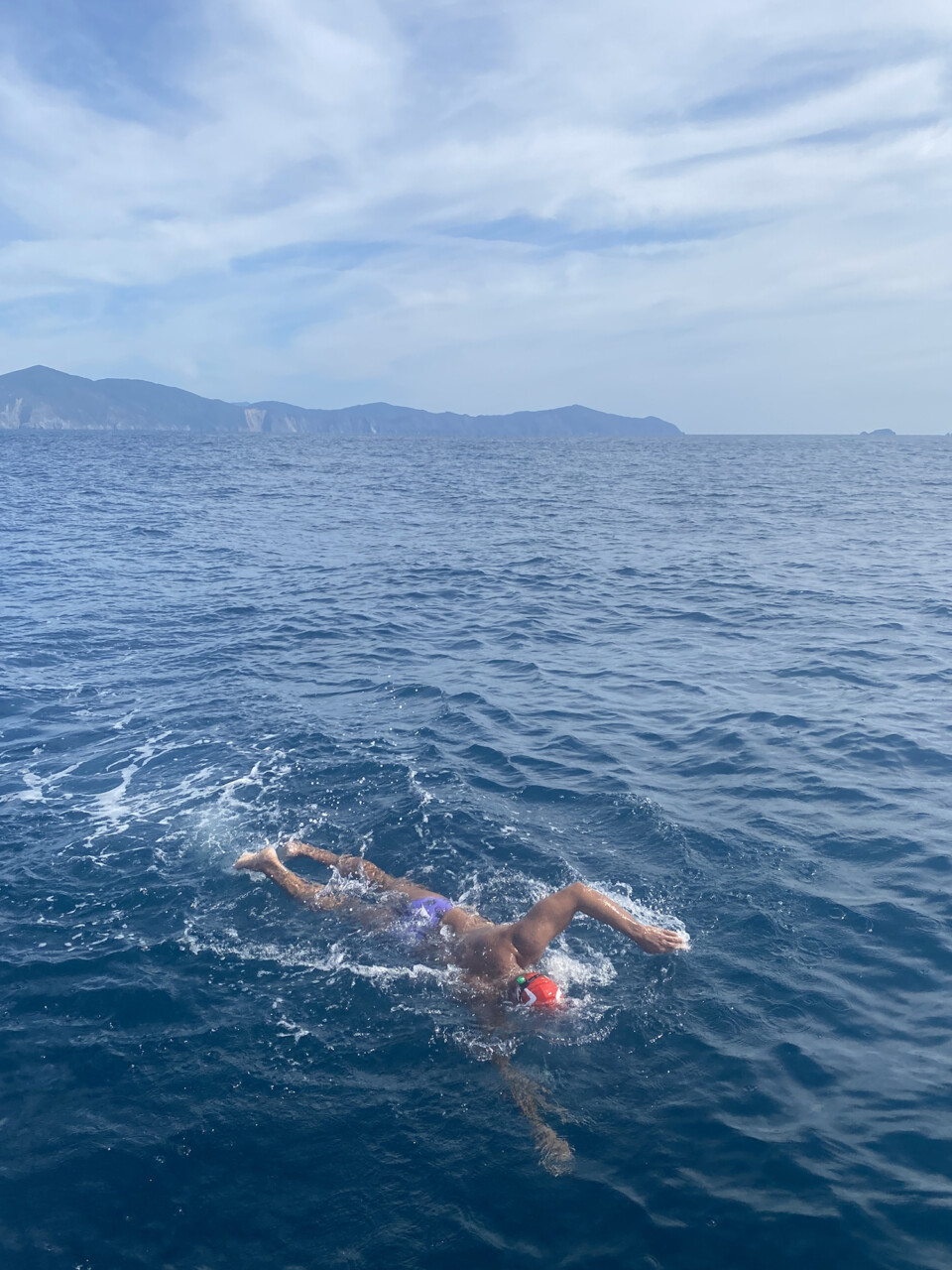
Then came the magic. Flat, glassy water. Crystal blue clarity. The sun warming my shoulders. I increased my stroke rate and settled into a strong rhythm, swimming with purpose. I focused on technique – glide, catch, pull – and repeated my mantras in time with my stroke to stay in the rhythm.
Feeds were every 30 minutes: isotonic drinks, carbohydrates, energy mixes, and my favourite – flat Coca Cola with two teaspoons of sugar. Rocket fuel. I swim feed-to-feed. Breaking a huge task into smaller ones is common advice, and it works. Even when you can see the North Island, it never seems to get closer until you can see the rocks or sand beneath you. So, I swim feed-to-feed to avoid overwhelming myself.
Dolphins
Halfway across, I saw a flash of grey beneath me. For a split second, I thought “shark”. Then I realised they were Hector’s dolphins – small, rare, and indigenous to New Zealand. Matt later told me they had been with me for an hour. Locals in the pub afterwards said they were protecting me from something bigger. A comforting thought in a place known for large sharks.
The Flood Tide
Then came the hardest part. The flood tide hit, and my pace collapsed to 500 metres per hour. For nearly six hours, I inched forward. My shoulders screamed. I felt disheartened when I realised how little distance I had covered. But I kept going. If you can swim, swim. Don’t stop.
Eventually, the sea floor appeared beneath me. Matt stripped off and swam the final stretch alongside to ensure I didn’t wash up against the rocks. Relief washed over me – relief from the pressure, the pain, and the fear of failure. I had done it. And I was unashamedly proud of myself for not stopping and completing the swim, one of the hardest I have undertaken. As the great Kiwi Sir Edmund Hillary said after coming down from summitting Mt Everest “…We have knocked the bastard off.”
Thanks
I owe this achievement to my family, Red Top Swimming, and Katabatic Charters, who, under the leadership of Grant Orchard, crew and pilot the support boat required for a Cook Strait crossing.
Team Forces and my regiment, the Irish Guards, kindly sponsored me and assisted in financing the challenge. I am extremely grateful to all parties for their emotional and financial support, which allowed me to achieve this dream of mine.
Team Forces is a charity dedicated to supporting the armed forces community through sports, challenges, and adventure, enhancing health and wellbeing. Their mission and purpose is to raise funds to support various activities that promote health, wellbeing, and recovery within the armed forces community. The charity focuses on providing opportunities for elite military athletes and facilitating participation in sports and adventurous activities, which are crucial for morale and motivation. I hope that some of the readers of this article may wish to support their endeavours in the future execution of their important work.